
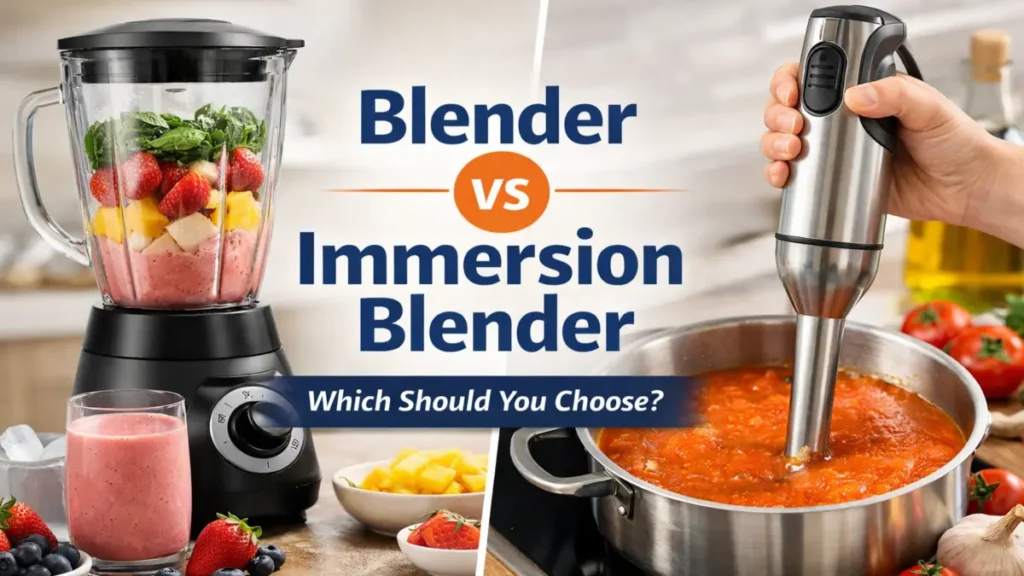
If you’re deciding between a countertop blender and an immersion blender (hand blender), you’re not alone. Both can blend ingredients, but they’re built for different kitchen tasks—and choosing the wrong one can lead to frustration, poor texture, or an appliance that sits unused.
In this guide, we’ll compare blender vs immersion blender in plain language, explain what each one does best, and help you choose the right option for your cooking style—whether you make smoothies, blend soups, or just want something quick and easy to clean.
Blender vs Immersion Blender at a Glance
| Feature | Countertop Blender | Immersion Blender (Hand Blender) |
|---|---|---|
| Best for | Smoothies, frozen fruit, larger batches | Soups in the pot, sauces, quick blends |
| Texture results | Very smooth (especially with power) | Good for light blends; varies by ingredients |
| Frozen ingredients | Usually better | Limited (depends on model + technique) |
| Batch size | Small to large | Small to medium |
| Cleanup | Jar + lid (moderate) | Usually quick (stick + cup) |
| Storage | Takes counter/cabinet space | Compact, easy to store |
| Typical use | Drinks + blending recipes | Cooking prep + hot soups |
Quick takeaway:
- Choose a countertop blender if you want smooth smoothies, frozen blending, and larger portions.
- Choose an immersion blender if you want quick blending in a pot or cup, especially for soups and sauces.
What Is a Countertop Blender Best Used For?
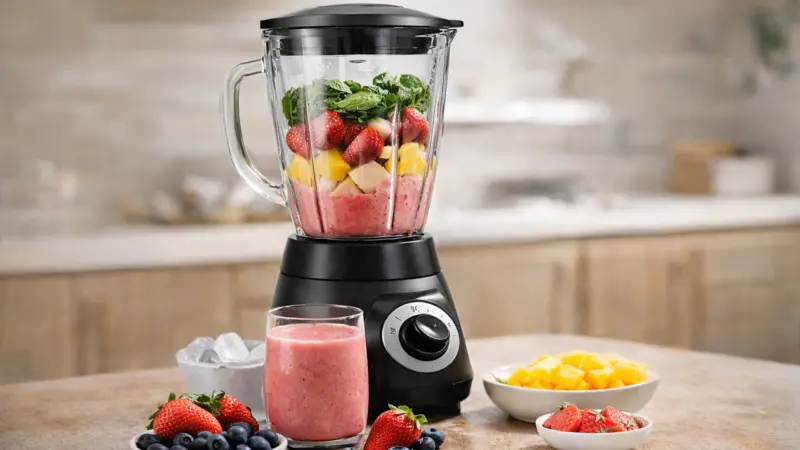
A countertop blender is designed to handle smooth, consistent blending, especially when you’re working with liquids, frozen ingredients, or larger portions. Its jar shape and high-speed blades help create a strong vortex, which pulls ingredients down and blends them evenly.
Countertop blenders are ideal for:
- Smoothies and protein shakes
- Frozen fruit and ice-based drinks
- Smooth purees and creamy sauces
- Blended soups (when transferring from a pot)
- Larger batches for families or meal prep
Because countertop blenders typically offer stronger, more consistent performance, they’re the better pick when texture matters—especially for thick smoothies or frozen blends.
Where countertop blenders can be less convenient:
- More parts to wash (jar, lid, blade assembly, depending on model)
- Takes more cabinet/counter space
- Not as quick for small “one-cup” blends unless you use a personal blender
What Is an Immersion Blender Best Used For?
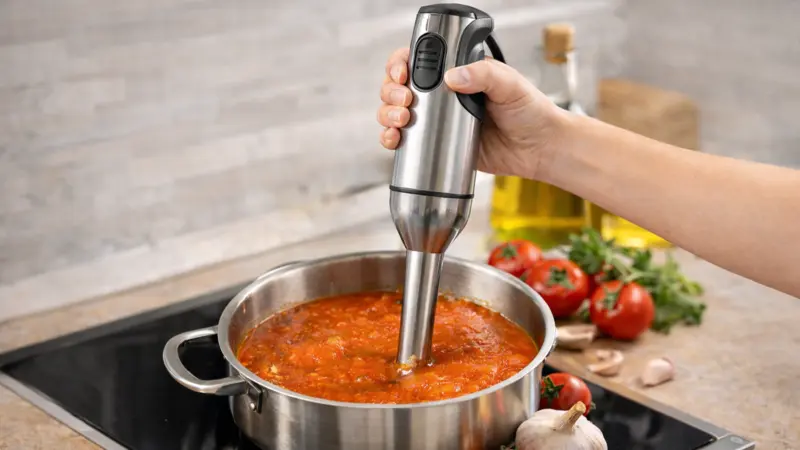
An immersion blender (hand blender) is built for quick, convenient blending—often directly in the pot, bowl, or cup. Instead of pouring ingredients into a jar, you bring the blender to the food. This makes immersion blenders especially useful for cooking tasks where you want to blend hot ingredients safely and with minimal cleanup.
Immersion blenders are ideal for:
- Blending soups directly in the pot (no transferring)
- Pureeing sauces, gravies, and curries
- Making small-batch smoothies or shakes (especially with soft fruit)
- Whipping cream or mixing light batters (with a whisk attachment, if included)
- Baby food and small purees
Immersion blenders are also a great choice if you have limited kitchen space or prefer a tool that’s easy to store and fast to clean.
Where immersion blenders have limitations:
- Struggles more with thick frozen blends and ice
- Results depend heavily on technique and container shape
- Smaller batch capacity compared to many countertop blenders
- Can leave small chunks in tougher ingredients (like fibrous greens)
Bottom line: If you blend soups, sauces, or small portions often—and want the easiest cleanup—an immersion blender can be the most practical option.
Key Differences Between a Countertop Blender and an Immersion Blender (What Actually Matters)
Both appliances blend, but they’re optimized for different outcomes. Here are the differences that matter most in real kitchens.
Power & Performance
- Countertop blender: Typically delivers stronger, more consistent blending—especially for frozen fruit, ice, and thick mixtures.
- Immersion blender: Power varies by model, and performance depends on your technique. Great for soft ingredients and hot liquids, but less reliable for hard frozen blends.
Quick takeaway: For demanding blends (ice/frozen), countertop blenders usually win.
Best Use Cases
- Countertop blender: Smoothies, shakes, smoothie bowls, frozen drinks, purees, and larger blending jobs.
- Immersion blender: Soups in the pot, sauces, quick purees, small batches, and fast everyday blending.
Quick takeaway: If you cook more than you “blend drinks,” immersion blenders can be surprisingly useful.
Batch Size & Convenience
- Countertop blender: Better for medium-to-large batches, but requires transferring ingredients into a jar.
- Immersion blender: Best for small-to-medium batches and allows blending where the food already is.
Quick takeaway: Immersion blenders are often faster for small jobs and hot foods.
Cleanup & Storage
- Countertop blender: More parts (jar + lid), and cleanup takes longer, though some models are dishwasher-safe.
- Immersion blender: Usually a quick rinse of the blending wand—especially convenient for daily cooking.
Quick takeaway: Immersion blenders are easier to store and easier to clean.
Texture Results
- Countertop blender: More likely to create a smooth, uniform texture—especially for smoothies and thick blends.
- Immersion blender: Can puree well, but may leave small bits in fibrous ingredients unless blended longer and in the right container.
Quick takeaway: If a perfectly smooth texture matters, countertop blenders are more reliable.
Blender vs Immersion Blender for Smoothies
For most people, a countertop blender is the better choice for smoothies—especially if you use frozen fruit, ice, or leafy greens. Countertop blenders are designed to create a strong blending vortex, which helps break down ingredients evenly for a smoother, more consistent texture.
That said, an immersion blender can still work for smoothies if your smoothies are simple and you blend in smaller portions.
Choose a countertop blender for smoothies if you:
- Use frozen fruit or ice regularly
- Blend fibrous greens (like spinach or kale)
- Want thicker smoothies or smoothie bowls
- Make smoothies for more than one person
An immersion blender can work for smoothies if you:
- Use softer fruits (banana, berries, mango)
- Add enough liquid for easier blending
- Blend small servings in a tall cup
- Prefer quick cleanup and minimal storage
Bottom line: If smoothies are a priority and you want the smoothest results with the least effort, a countertop blender is the safer pick. If you only make occasional, simple smoothies and value easy cleaning, an immersion blender can be a practical alternative.
If smoothies are your main goal, a countertop blender is usually the best tool. You can explore top-performing options in our guide to best blenders for smoothies.
Blender vs Immersion Blender for Soups
For soups, an immersion blender is often the better and safer choice, especially when you’re blending hot ingredients.
Immersion blenders let you blend directly in the pot, which means you don’t have to transfer hot soup into a blender jar in batches. This reduces mess, saves time, and lowers the risk of spills or steam pressure popping a blender lid.
Choose an immersion blender for soups if you:
- Make soups often (tomato, lentil, vegetable, pumpkin, etc.)
- Want to puree soup in the same pot
- Prefer quick cleanup
- Need a compact tool for everyday cooking
A countertop blender can be better for soups if you:
- Want an ultra-smooth “restaurant-style” texture
- Don’t mind blending in batches and letting the soup cool slightly
- Need to puree large amounts at once (meal prep)
Bottom line: For everyday soup-making, immersion blenders are usually more convenient. For the smoothest possible texture, a countertop blender can still be worth it—just be careful when blending hot liquids.
Which One Should You Buy Based on Your Needs?
The right choice depends on what you make most often and how you use your kitchen day to day. Many households don’t need both.
Choose a Countertop Blender if you:
- Make smoothies, shakes, or frozen drinks regularly
- Use frozen fruit, ice, or leafy greens
- Want consistently smooth results with minimal effort
- Blend larger portions for family or meal prep
Choose an Immersion Blender if you:
- Make soups, sauces, and purees frequently
- Want to blend directly in a pot or bowl (less mess)
- Prefer fast cleanup and compact storage
- Need a practical tool for everyday cooking tasks
Consider owning both if you:
- Make smoothies often and cook soups/sauces regularly
- Want one appliance for drinks and another for cooking
- Have the storage space and will use both consistently
Quick takeaway:
Smoothies & frozen blends → countertop blender
Soups & sauces → immersion blender
Frequently Asked Questions
Is an immersion blender as good as a blender for smoothies?
An immersion blender can work for simple smoothies made with soft fruits and enough liquid, but it usually struggles with ice, frozen fruit, and fibrous greens. For smoother, more consistent smoothies, a countertop blender is typically better.
Can an immersion blender replace a countertop blender?
It depends on what you make. An immersion blender can replace a countertop blender for soups, sauces, and small purees, but it usually can’t match a countertop blender for frozen blends, thick smoothies, or larger batches.
Which is better for soup, a blender or an immersion blender?
An immersion blender is often better for soup because you can blend directly in the pot, which is safer and more convenient for hot liquids. A countertop blender can create a smoother texture, but it usually requires blending in batches.
Final Thoughts
Countertop blenders and immersion blenders are built for different jobs. If your priority is smoothies, frozen blends, and consistent texture, a countertop blender is the stronger choice. If you cook often and want quick blending for soups, sauces, and everyday prep, an immersion blender is usually more convenient and easier to clean.
The best option is the one that matches what you’ll actually use most. Choose based on your routine, not features you won’t need.